Mr. Dent Collision Repair Publishes Collision Repair Guidance for Marshfield Drivers After a Rural Road Accident
Ozark, MO - October 28, 2026 - PRESSADVANTAGE - Mr. Dent Collision Repair has published new consumer guidance
Press Release Disclaimer: This is a press release distributed through the XPR Media network. It has not been independently verified by our newsroom.

Ozark, MO – October 28, 2026 – PRESSADVANTAGE –
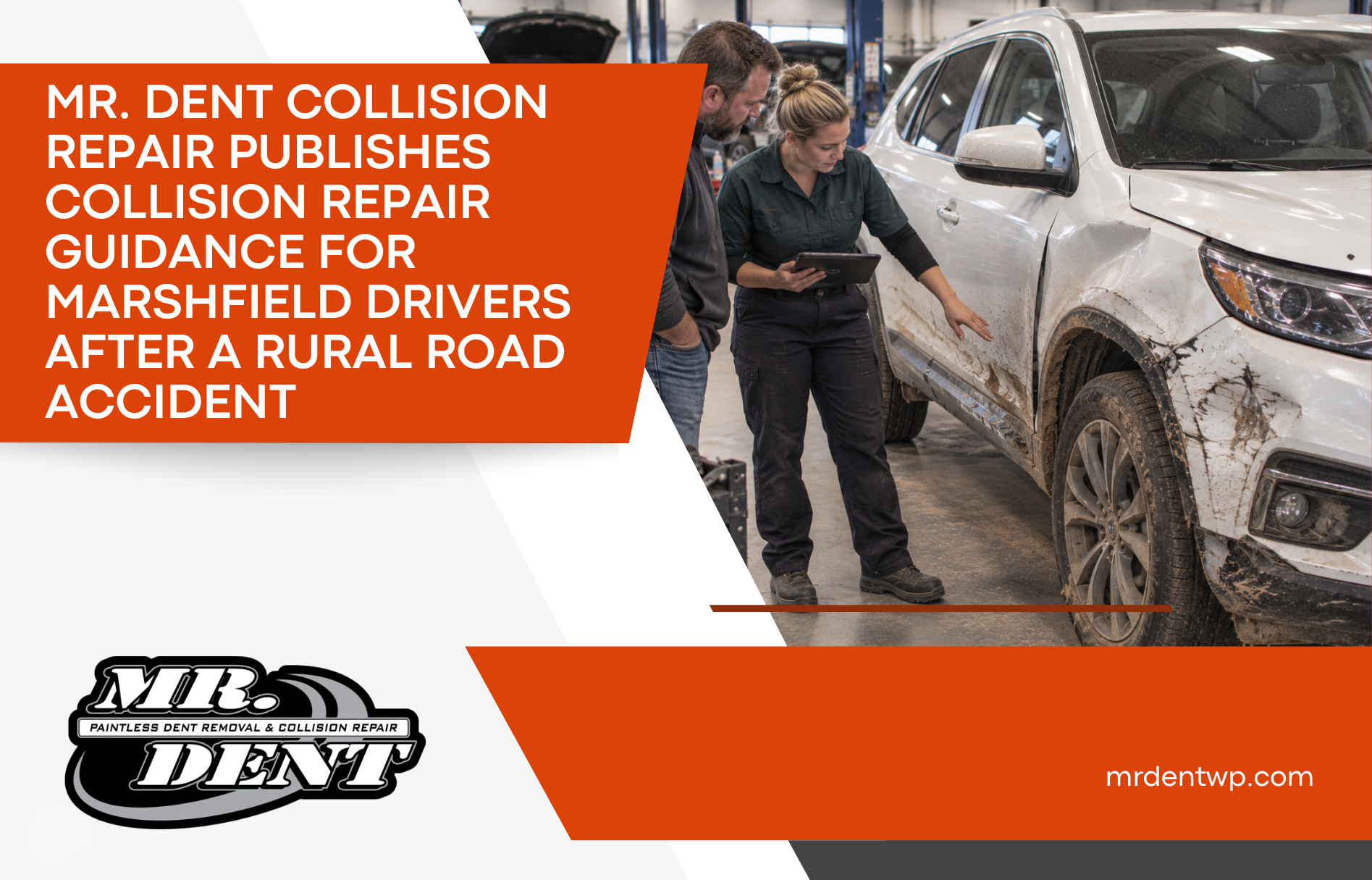
Mr. Dent Collision Repair has published new consumer guidance introducing a three-stage framework for evaluating vehicle damage after rural-road accidents. The October guidance focuses specifically on accidents that can involve more than one contact event, such as an initial collision with wildlife, debris, or a roadside object followed by contact with a ditch, shoulder, embankment, uneven terrain, or another obstacle.
The new resource differs from the company’s broader collision repair information by organizing rural-road damage according to the sequence of the accident. The framework separates the initial point of impact, damage involving adjoining components, and areas associated with secondary contact. This approach is intended to help consumers understand how several separately documented areas of damage can result from one rural-road event.
The first stage begins with the primary impact. Wildlife and roadside-object collisions can involve the bumper, grille, hood, fender, lamps, or other exterior components depending on the height, direction, and location of contact. An angled collision can concentrate damage around one corner of the vehicle, while another impact may involve a broader portion of the front or side.
Visible evidence can include dents, cracked exterior components, damaged paint, broken lamps, displaced trim, or changes in the relationship between adjoining panels. These conditions establish a starting point for determining which components were involved.
The second stage follows physical evidence from the primary impact into adjoining components. A front-corner collision, for example, can involve components positioned closely together, including a bumper, fender, lamp, grille, and hood edge. Side contact with a branch, fence, roadside marker, or similar object can leave scratches, dents, or gouges extending across more than one panel.
The purpose of this stage is not to presume that every nearby component has been damaged. Instead, the assessment follows documented evidence from the point of contact into other areas associated with the event.
This approach is consistent with I-CAR technical information concerning indirect collision damage. I-CAR, a nonprofit organization that provides collision repair education and technical resources, explains that impact forces can create damage beyond the most obvious area and that indirect damage can require inspection to identify. Readers can review the organization’s technical discussion in Sometimes Indirect Damage Can Be Sneaky.
Exterior panels involved in the accident can then be evaluated according to their individual condition. Mr. Dent Collision Repair’s auto body repair information provides additional context for repairs involving painted body surfaces, dents, scratches, gouges, and damaged exterior components.
Paint condition can be particularly relevant after contact with branches, debris, fencing, or other roadside objects. One incident may leave surface-level marks, while another can penetrate additional coating layers or deform the underlying panel. Dents can also vary in shape, depth, location, and effect on the surrounding finish.
The third stage is the primary feature that distinguishes the newly published rural-road guidance from general collision assessment information. It considers whether the vehicle experienced a second contact after the original impact.
A driver avoiding wildlife or another obstruction can leave the paved surface. The vehicle may then encounter a shoulder, ditch, embankment, uneven ground, vegetation, debris, or another roadside object. This creates the possibility of a separate damage area that is not necessarily adjacent to the first point of impact.
For example, an initial front-end collision can be followed by contact along a lower portion of the vehicle. Depending on the actual path of the vehicle, lower bumper areas, rocker sections, wheel-opening components, liners, shields, or other low-mounted parts may warrant inspection.
The new framework uses the accident sequence to identify those areas without assuming that secondary damage occurred. Evidence on the vehicle remains the basis for determining what was actually affected.
This distinction is important because a rural-road accident can produce two physically separate damage patterns during one event. The most visible dent or cracked component may identify the first contact, while marks elsewhere can correspond with a subsequent interaction with the roadside environment.
Wildlife collisions illustrate the framework. A collision involving an animal can be concentrated around the bumper and grille or extend toward a lamp, hood, fender, or adjoining component. If the vehicle remains on the roadway, the assessment may remain centered on that impact pattern. If the vehicle subsequently leaves the road and contacts another surface or object, the second contact can be documented separately.
The same approach can be applied to loose debris or fallen objects. A branch can produce a sequence of scratches along adjoining panels, while a larger object can create a more concentrated impact. The physical evidence determines whether marks on different components are consistent with the same event.
When access to an affected area is limited, further inspection can sometimes be necessary to document its condition. This does not mean concealed damage should automatically be expected. The purpose of additional access is to determine whether damage is present rather than infer it from exterior appearance.
I-CAR’s technical resources also emphasize the role of vehicle-specific repair information in collision planning. The organization’s OEM Technical Information Matrix identifies categories of manufacturer information that may be available to repair professionals, including body construction, repair procedures, attachment methods, and corrosion-protection information.
Vehicle-specific information becomes relevant after the affected components have been identified because construction and repair procedures can vary among vehicles. A bumper cover, exterior metal panel, lamp assembly, lower shield, or other component may have different repair considerations depending on the vehicle and the damage documented during inspection.
Modern vehicles can also contain electronic equipment in exterior areas. Depending on the model and configuration, wiring, sensors, cameras, or related components can be positioned within or near bumpers, mirrors, lamps, and other body areas.
The presence of this equipment does not establish that electronic work or calibration is required after every rural-road accident. The components affected, operations performed during repair, vehicle configuration, and manufacturer procedures determine what applies to an individual repair.
I-CAR addresses these considerations in its collision repair diagnostic resources, which discuss the role of OEM information in determining scanning and calibration requirements. The organization’s technical resources are available through the I-CAR Repairability Technical Support portal.
Another element of the new guidance concerns the difference between drivability and documented body damage. A vehicle that remains capable of moving after an accident can still have exterior components requiring evaluation or repair. At the same time, a visually significant dent does not establish that unrelated or concealed areas were also damaged.
The three-stage framework is designed to keep those conclusions tied to physical evidence. The first stage establishes where the collision began. The second identifies adjoining components supported by the impact pattern. The third considers separate areas associated with documented secondary contact.
Photographs can provide additional context when they can be taken safely. Images of the initial impact area, secondary contact marks, and the general pattern of exterior damage can help document the event. Information about whether the vehicle remained on the roadway or contacted a ditch, shoulder, or roadside object can also help explain why physically separate areas are being evaluated.
The framework is narrower than general collision repair guidance because it focuses specifically on the sequence of rural-road accidents. Rather than presenting wildlife strikes, roadside-object collisions, and roadway departures as unrelated categories, the new resource provides one method for evaluating them based on how contact progressed during the incident.
That distinction is the central addition in the October publication. A rural-road accident is evaluated as a sequence of documented contact points rather than according to the largest visible area of damage.
For drivers in the Marshfield area, the framework can make a repair plan easier to understand when several components are listed after one accident. A bumper damaged during the initial impact, an adjoining fender affected by the same contact, and a lower component damaged during a subsequent roadway departure represent different findings even though they occurred during one event.
Each finding can then be evaluated according to the condition of the component and the applicable vehicle-specific repair information. This allows the repair scope to follow documented evidence rather than a generalized assumption about what typically occurs during a rural-road collision.
The October rural-road guidance is being published as part of Mr. Dent Collision Repair’s consumer information for Southwest Missouri drivers. Consumers can access the company’s existing repair information through its collision repair and auto body repair resources, while the independent I-CAR links cited in the publication provide additional technical context for indirect damage and manufacturer repair information.
Additional company information is available through the Mr. Dent Collision Repair About Us page.
Mr. Dent Collision Repair provides collision repair, auto body repair, paintless dent repair, glass repair, and related vehicle repair services for Southwest Missouri vehicle owners. The October consumer guidance adds a rural-road-specific accident-sequence framework to the company’s existing repair information, focusing on the initial impact, documented involvement of adjoining components, and evidence of secondary contact before the repair scope is established.
###
For more information about Mr. Dent Collision Repair, contact the company here:
Mr. Dent Collision Repair
Logan Martin
417-581-5103
logan@mrdentmo.com
2116 N 20th St, Ozark, MO 65721, United States