World Cerebral Palsy Day: Guntur Neurosurgeon Says Severe Spasticity Should Not Simply Be Accepted as ‘Part of CP’
Dr. Rao’s IIN reports surgical treatment of 104 patients with cerebral palsy and calls for earlier specialist
Press Release Disclaimer: This is a press release distributed through the XPR Media network. It has not been independently verified by our newsroom.
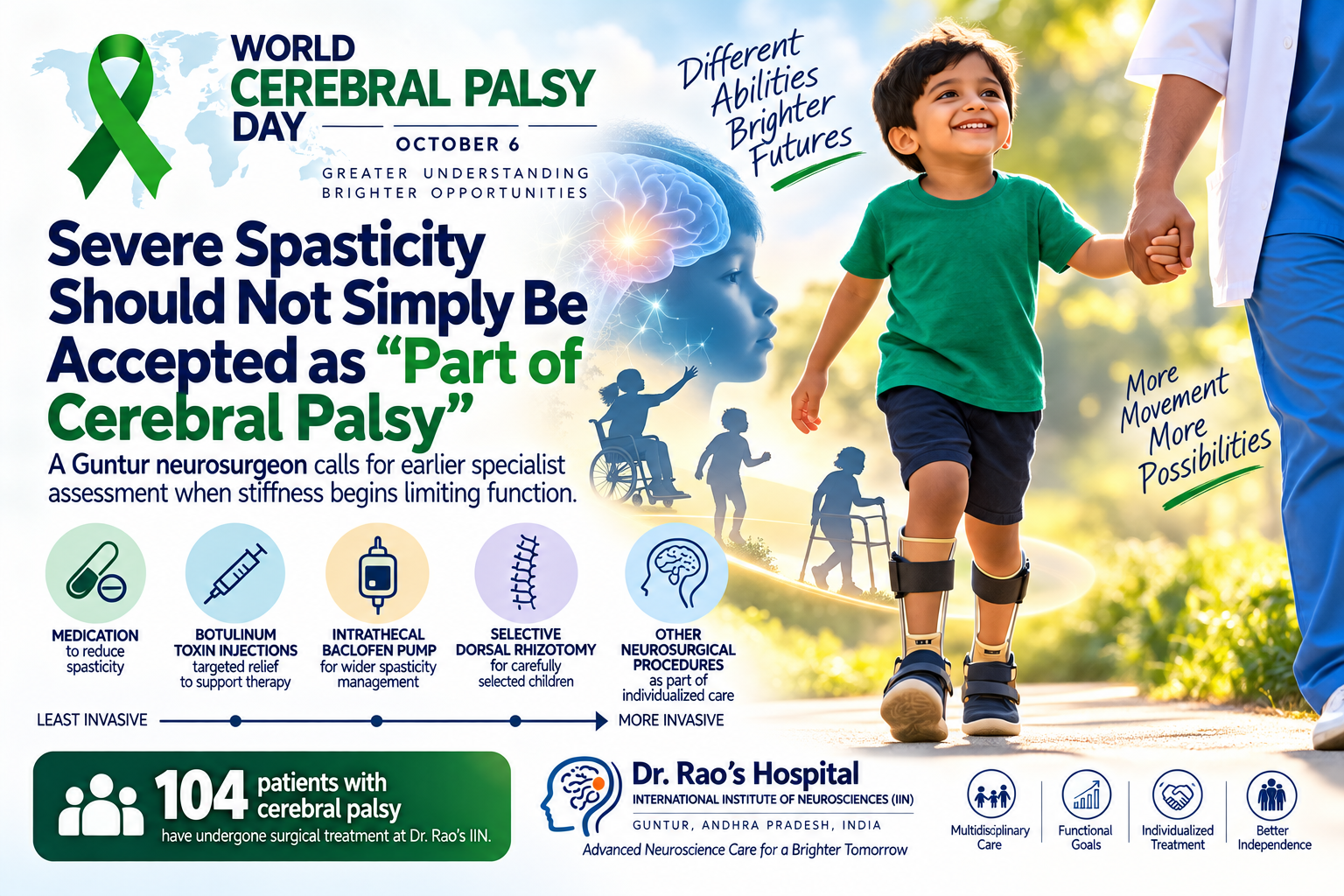

Dr. Rao’s IIN reports surgical treatment of 104 patients with cerebral palsy and calls for earlier specialist assessment when stiffness begins limiting function
GUNTUR, ANDHRA PRADESH, INDIA, October 7, 2026 /EINPresswire.com/ — A child with cerebral palsy may have movement that is physically possible but functionally restricted by severe muscle stiffness. On World Cerebral Palsy Day, a Guntur neurosurgeon is urging families and clinicians to ask an often-overlooked question earlier in the care pathway: is treatable spasticity contributing to the child’s disability?
Dr. Mohana Rao Patibandla, Chief Neurosurgeon and founder of Dr. Rao’s Hospital – International Institute of Neurosciences (IIN) in Guntur, says the issue is not whether every child with cerebral palsy should undergo neurosurgery. Instead, children with significant, function-limiting spasticity should have timely specialist assessment so that neurological, medical, rehabilitation, orthopaedic and, where appropriate, neurosurgical options can be considered.
Dr. Rao’s IIN reports that 104 patients with cerebral palsy have undergone surgical treatment at the institution.
“Cerebral palsy itself is not something neurosurgery can cure. But severe spasticity should not automatically be accepted as something a child simply has to live with indefinitely,” said Dr. Mohana Rao Patibandla. “The important question is whether abnormal muscle tone is preventing a child from using movement that is already present. If it is, we should assess whether reducing that spasticity could make movement, daily activities and rehabilitation more effective.”
The overlooked question in cerebral palsy care
Cerebral palsy is a lifelong disorder of movement and posture caused by disturbances in the developing brain. Its clinical presentation varies considerably between children.
Some children have predominantly spasticity, while others have dystonia, weakness, impaired coordination or combinations of these problems. The distinction is important because the same treatment is not appropriate for every child.
NICE guidance recognizes abnormalities of tone, including spasticity and dystonia, as important components of cerebral palsy assessment. Its guidance on spasticity in children and young people recommends considering selective dorsal rhizotomy (SDR) for carefully selected children with spasticity affecting the lower limbs, particularly those at GMFCS levels II or III. NICE emphasizes specialist multidisciplinary selection, discussion of the irreversible nature of SDR, known complications and uncertainty around long-term outcomes.
SDR is a neurosurgical procedure in which selected sensory nerve rootlets contributing to lower-limb spasticity are divided to reduce abnormal muscle tone.
Because the procedure is irreversible, the decision should never be based on the diagnosis of cerebral palsy alone.
The question should come before the operation
Dr. Rao says the conversation with families should not begin with:
“Does my child need surgery?”
It should begin with:
“What is actually limiting my child’s function, and is any part of it treatable?”
That distinction is important because cerebral palsy management is multidisciplinary.
Depending on the individual child, treatment may include physiotherapy, occupational therapy, oral antispastic medications, botulinum toxin injections, intrathecal baclofen, orthopaedic procedures or selected neurosurgical interventions such as SDR.
“The mistake is to think of neurosurgery as the opposite of rehabilitation,” Dr. Rao said. “In appropriately selected children, reducing abnormal tone can be part of creating a better environment for rehabilitation. Surgery is not the end of treatment. It is one component of a much longer rehabilitation pathway.”
Why earlier assessment matters more than earlier surgery
Dr. Rao’s message is not that children should undergo surgery earlier simply because they have cerebral palsy.
It is that significant spasticity should be recognized and assessed before it becomes an unquestioned explanation for every functional limitation.
Specialist assessment may be particularly relevant when increasing stiffness interferes with walking, sitting, transfers, dressing or hygiene; when functional progress has plateaued despite appropriate rehabilitation; when repeated focal treatments provide only temporary benefit; or when it is unclear whether spasticity, dystonia, weakness or another neurological problem is the dominant limitation.
The objective is to identify the child’s modifiable problems and establish realistic functional goals.
What the evidence says about selective dorsal rhizotomy
The evidence surrounding SDR supports a careful rather than promotional approach.
A 2025 systematic review and meta-analysis found significant improvements in measures of lower-limb spasticity and gross motor function after SDR in children with cerebral palsy, while also noting limitations in the available evidence and follow-up.
Long-term reviews, however, have highlighted important uncertainties regarding functional outcomes and the quality and consistency of the evidence. A systematic review of studies with at least 10 years of follow-up concluded that the available evidence remained limited and heterogeneous.
Potential complications also need to be considered. A systematic review of SDR complications identified structural and neurological complications reported in the literature, reinforcing the importance of careful patient selection and long-term surveillance.
For Dr. Rao, these findings reinforce rather than weaken the case for specialist assessment.
“The evidence does not support offering SDR to every child with cerebral palsy,” he said. “It supports selecting the right child, having an experienced multidisciplinary team, discussing what is known and what remains uncertain, and making sure that intensive rehabilitation is available after treatment.”
104 patients: institutional experience, not a promise of outcome
Dr. Rao’s IIN reports surgical treatment of 104 patients with cerebral palsy.
The institution says this experience has reinforced the importance of individualized treatment rather than applying a single procedure to every child.
Dr. Rao’s IIN evaluates and provides a range of approaches to clinically significant spasticity, including medical management, botulinum toxin therapy, intrathecal baclofen and selected neurosurgical procedures.
The hospital emphasizes that the decision to operate is based on the individual child’s neurological examination, functional limitations, pattern of tone, goals, rehabilitation potential and multidisciplinary assessment.
Three questions families should ask
Dr. Rao’s IIN recommends that families ask three questions during a specialist assessment:
1. Is the main problem spasticity, dystonia, weakness or a combination of these?
2. What voluntary movement does the child already have that may be hidden or restricted by abnormal muscle tone?
3. If treatment reduces the abnormal tone, what specific rehabilitation programme will help the child use the movement that remains?
“These questions move the conversation away from simply asking how to reduce muscle stiffness,” Dr. Rao said. “They bring the discussion back to the real goal—what can we do to improve the child’s function and independence?”
A different conversation for World Cerebral Palsy Day
World Cerebral Palsy Day is an opportunity to recognize the millions of people living with cerebral palsy and the families and professionals supporting them.
Dr. Rao believes awareness should extend beyond the diagnosis itself to the potentially modifiable factors that influence function throughout childhood.
“We should never promise a family that an operation will make their child ‘normal,’” Dr. Rao said. “That is not the purpose of cerebral palsy surgery. The purpose is to identify what may be modifiable, reduce barriers to movement where appropriate, and give the child the best possible opportunity to use the function they have.”
The message from Dr. Rao’s IIN is therefore not that every child with cerebral palsy needs neurosurgery.
It is that severe, function-limiting spasticity deserves specialist assessment rather than being automatically accepted as an unavoidable part of cerebral palsy.
Selected Clinical Evidence
National Institute for Health and Care Excellence (NICE). Cerebral palsy in under 25s: assessment and management. NICE Guideline NG62. Published January 25, 2017; reviewed September 19, 2024.
National Institute for Health and Care Excellence (NICE). Spasticity in under 19s: management. NICE Guideline CG145. Recommendations include consideration of selective dorsal rhizotomy for appropriately selected children and young people with spasticity at GMFCS levels II or III, with multidisciplinary assessment and discussion of irreversibility, complications and uncertainty around long-term outcomes.
Otero-Luis I, et al. Efficacy of selective dorsal rhizotomy in the treatment of spasticity in children with cerebral palsy: a systematic review and meta-analysis. Journal of Neurosurgery: Pediatrics. 2025;35(6):571–580. doi:10.3171/2024.11.PEDS24398.
Himmelmann K, et al. Long-term effects of selective dorsal rhizotomy in children with cerebral palsy: a systematic review. Developmental Medicine & Child Neurology. 2019. The review found that long-term evidence remained limited and heterogeneous, emphasizing the need for further robust research.
Systematic review of complications following selective dorsal rhizotomy in cerebral palsy. The review identified multiple structural and neurological complications reported after SDR and emphasized ongoing surveillance during skeletal growth.
About Dr. Rao’s Hospital – International Institute of Neurosciences (IIN)
Dr. Rao’s Hospital – International Institute of Neurosciences (IIN) in Guntur, Andhra Pradesh, is a dedicated neurosciences centre providing neurosurgical and neurological care, including pediatric neurosurgery, minimally invasive neurosurgery, skull base surgery, cerebrovascular and endovascular neurosurgery, neuro-oncology and stereotactic radiosurgery.
The institution incorporates advanced neurosurgical infrastructure including intraoperative neurophysiological monitoring, neuronavigation, a hybrid operating theatre and a biplane catheterisation laboratory.
About Dr. Mohana Rao Patibandla
Dr. Mohana Rao Patibandla is a neurosurgeon based in Guntur with training and experience spanning pediatric neurosurgery, minimally invasive neurosurgery, skull base surgery, cerebrovascular and endovascular neurosurgery, neuro-oncology and stereotactic radiosurgery. He is the founder and Chief Neurosurgeon of Dr. Rao’s Hospital – International Institute of Neurosciences.
Media Contact
Dr. Rao’s Hospital – International Institute of Neurosciences (IIN)
Old Bank Street, Kothapeta, Guntur, Andhra Pradesh, India
Phone: 9010056444
Email: info@drraoshospitals.com
Mohana Rao Patibandla
Patibandla Narayana Swamy Neurosciences LLP
+ +91 90100 56444
info@drraoshospitals.com
Visit us on social media:
LinkedIn
Instagram
Facebook
YouTube
X
Dr. Rao’s Hosptial – the best neurosurgery hospital in India – with medical tourism
Legal Disclaimer:
EIN Presswire provides this news content “as is” without warranty of any kind. We do not accept any responsibility or liability
for the accuracy, content, images, videos, licenses, completeness, legality, or reliability of the information contained in this
article. If you have any complaints or copyright issues related to this article, kindly contact the author above.

Media gallery